


Ask ten people what a Product Manager does, and you’ll get eleven answers, three of them contradictory, and at least one person will say “oh, like a project manager?” and you will feel your soul leave your body.
Here’s the uncomfortable truth nobody puts in the job description: PMs don’t build anything. No code ships because of you. No pixel exists because you drew it. You will not write a single line that ends up in production, and yet somehow, if the product fails, everyone looks at you.
So what is the job, actually?
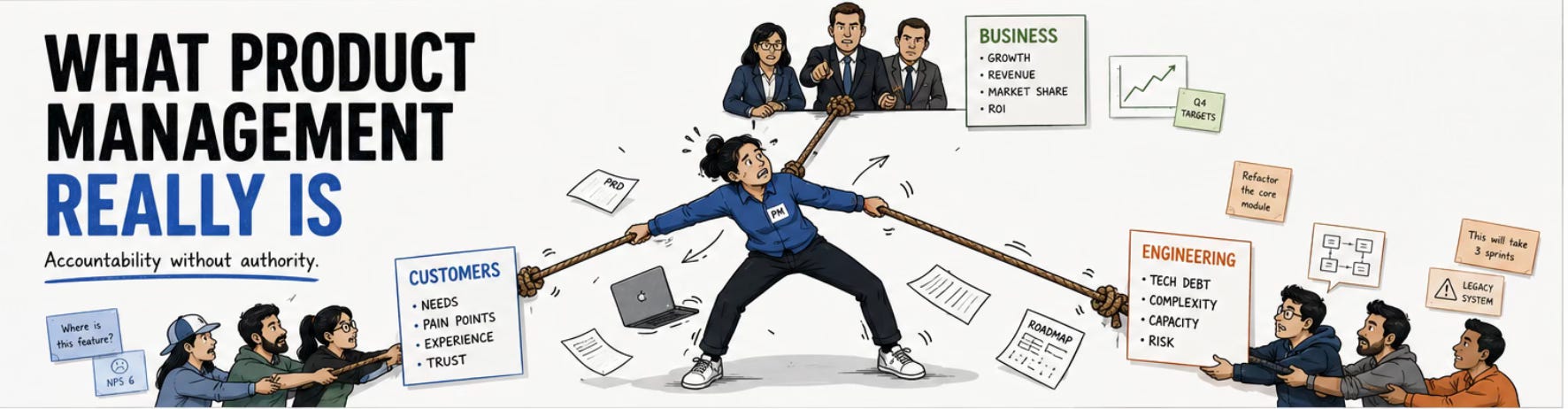
You are the only person in the building whose entire function is to live in the friction between three things that constantly want to pull apart: what customers need, what the business needs, and what engineering can realistically build in the time available. That’s it. That’s the job. Everything else, the roadmaps, the user stories, the endless Jira tickets, is just the paperwork of managing that tension.
The Triangle Nobody Draws Correctly
Most explanations of PM work draw a triangle with “user experience,” “business viability,” and “technical feasibility” at the corners and the PM sitting smugly in the middle like a UN peacekeeper. Cute diagram. Mostly useless in practice.
Here’s what actually happens. Engineering wants to refactor the codebase because it’s held together with duct tape and prayer. Sales wants a feature that will close three enterprise deals next quarter. Customers, when you actually talk to them, want something completely different from both of those, usually something smaller and more boring than anyone in the building expects.
Your job is not to make all three happy. That’s impossible and anyone who tells you otherwise is selling you a framework. Your job is to figure out which of these competing pulls actually matters right now, build the argument for why, and then have that argument survive contact with a VP who disagrees with you in a meeting.
This is why “PM is the CEO of the product” is one of the most damaging phrases ever coined. CEOs have authority. They can fire people, allocate budget, set strategy and have it stick because they signed the org chart. PMs have none of that. You have influence, and influence has to be earned every single week, in every single meeting, through the quality of your thinking and not the size of your title.
The Real Job Is Translation, and Translation Is Brutal

Here’s something senior PMs know that junior PMs learn the hard way: the hardest part of the job isn’t deciding what to build. It’s translating between groups of people who are technically speaking English but functionally speaking different languages.
Engineering says “this will take three sprints.” What they mean is “this will take three sprints if nothing breaks, nobody gets sick, and the API we depend on doesn’t change underneath us, which it will.”
Sales says “the customer needs this by end of quarter.” What they mean is “I told the customer this would exist because I needed to close the deal and I am now retroactively making that true by telling you about it.”
Customers say “I want a dashboard.” What they actually want, nine times out of ten, is to stop feeling anxious about whether something bad is happening that they don’t know about. The dashboard is just the shape that anxiety takes when you ask someone to describe a solution instead of a problem.
A good PM hears all three of these and does not write any of them down literally. A good PM asks why, again, and again, until the actual problem surfaces, because the actual problem is almost never the first thing anyone says.
Why “Alignment” Sounds Soft But Is Actually the Hardest Skill in Tech
People hear “alignment” and think of corporate buzzword bingo. Stakeholder alignment. Cross-functional alignment. It sounds like the kind of thing that happens in a meeting with a whiteboard and someone’s name is Karen.
But alignment, done properly, is one of the most intellectually demanding things you can do in a company. It means holding three or four mutually exclusive versions of reality in your head at once, finding the version of the truth that lets the most important people move forward without lying to any of them, and then communicating that version so clearly that an engineer, a designer, and a finance person all walk away with the same understanding of what’s about to happen.
Get it wrong and you get the classic startup disaster: three months of engineering effort spent building the wrong thing because everyone assumed someone else had already checked it made sense.
This is also why the best PMs are often the ones nobody notices. When alignment works, it’s invisible. The team just... ships the right thing, on time, and everyone assumes that’s normal. When it fails, it’s catastrophic and very, very visible, and guess whose name is on the postmortem.
The Part Nobody Tells You: You Are Accountable for Everything and You Control Almost Nothing
This is the sentence that should be tattooed on every PM job posting, right under “fast-paced environment” and “wear many hats.”
You will be held accountable for metrics you cannot directly move. Retention dropped? That’s a PM problem, even though retention is downstream of product quality, support quality, pricing, onboarding, market conditions, and whether a competitor just launched something shinier. Engagement is flat? PM problem, even if the real cause is that marketing brought in the wrong users last quarter and nobody told you.
You don’t control engineering’s calendar. You don’t control design’s bandwidth. You don’t control the CEO’s pet feature that just jumped the queue because they saw a competitor’s tweet. What you control is your judgment, your ability to say no convincingly, and your ability to make the case for what matters before someone else makes the case for what doesn’t.
This is why the cliché “PM is the hardest job with the least authority” isn’t just a complaint, it’s basically the job description. The authority gap is the job. If you had full authority, you’d be a CEO, and the role wouldn’t need to exist, because someone could just decide things and be done with it. PM exists precisely because decisions need to be made by someone who doesn’t get to simply decree them.
So What Actually Makes Someone Good at This?
Not charisma. Not a Stanford MBA. Not knowing how to write the perfect PRD template, although that helps with the paperwork.
What separates good PMs from bad ones is almost always one thing: the quality of the questions they ask before anyone starts building anything. Bad PMs ask “how do we build this.” Good PMs ask “should we build this, and what happens if we’re wrong.”
The best PMs I’ve studied all share a slightly uncomfortable trait: they’re comfortable being the person in the room who slows things down. Not because they like friction, but because they’ve learned that a week spent figuring out the right problem saves a quarter spent building the wrong solution beautifully.

That’s the job. Not building. Not managing, not really, despite the title. Figuring out what’s true, what matters, and what to do about it, with imperfect information, competing incentives, and zero formal power to make anyone listen to you.
If that sounds exhausting, it is. It’s also, when it clicks, one of the most intellectually alive jobs in tech, because you’re never just an engineer, never just a businessperson, never just a researcher. You’re all three, badly, all the time, and somehow that’s the point.